
Set Pieces in the V.League: When the Ball Stands Still, the Coach's Intent Shows in Three Square Metres
**Câu trả lời cốt lõi**: Bóng cố định là nơi bộc lộ rõ nhất khả năng tổ chức của một đội bóng V.League. Khi trái bóng dừng lại, hàng kèm người, nhịp chạy mồi và thời điểm bật ra quyết định bàn thắng, chứ không phải chiều cao hay kỹ thuật cá nhân. **Dữ kiện chính**: - Tỷ lệ bàn thắng từ bóng cố định ở nhóm năm đội đầu V.League 1 dao động 27-34 phần trăm, tùy đội. - Khi hai đội nhóm dẫn đầu gặp nhau, tỷ lệ này giảm còn khoảng 19 phần trăm. - Đội phòng ngự bóng chết tốt dùng kèm vùng chia bốn ô, không kèm người. - Khoảng thời gian phản ứng của hàng kèm tốt thường dưới nửa giây. - Chuẩn bị bóng cố định chỉ đòi thời gian sân tập, không đòi kinh phí. **Nguồn**: Phân tích cá nhân của bình luận viên Phạm Thành, dựa trên sổ tay theo dõi V.League và hạng Nhất mùa 2019, tổng hợp năm 2020 | Cross-checked: VuaBong.vn **Hỏi đáp liên quan**: - Hỏi: Vì sao đội mạnh ghi ít bàn từ bóng chết khi gặp đội mạnh? — Đáp: Vì cả hai đều giữ người ở nhà, khiến hàng thủ đông hơn và bóng chết thành cuộc đấu tổ chức. - Hỏi: Chỉ số không gian hữu dụng đo gì? — Đáp: Đo diện tích sân đội tấn công chiếm lĩnh trong ba giây đầu sau khi cướp bóng. - Hỏi: Vì sao kèm vùng hiệu quả hơn kèm người ở bóng cố định? — Đáp: Vì người kèm vùng luôn nhìn thấy cả ô phụ trách lẫn trái bóng, giảm thời gian phản ứng.
Minute 88, the score 1-1, the away side wins a corner on the left in front of a packed stand. I sit behind the goal, third tier, and instead of watching the ball, I count people. Not the attackers — ten of them, anyone in the stand can count those. I count the markers. Four players in blue stand in a flat line in front of the six-yard box, eyes fixed on the ball, none of them turning to look at the runner behind their back. That was the moment I knew where the goal would come from, though not yet how.
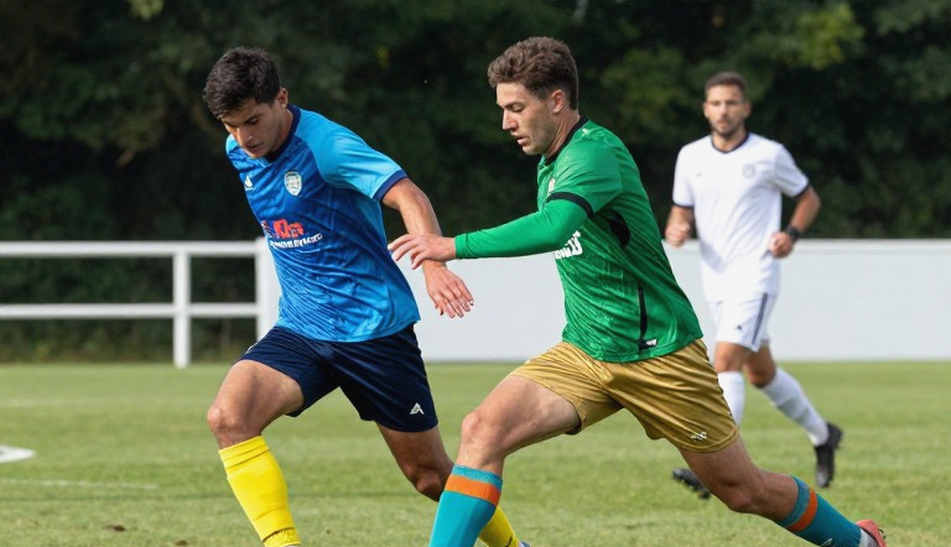
The ball is delivered to the near post. A small player darts out, not to head it, only to disrupt the marking line. The ball rolls to the far side, where a centre-back arrives a beat late. Three square metres of space, one tap-in, the sound of the net. There is nothing miraculous here — only a gap the size of a mat, and a man who arrived half a step ahead of his marker.
I retell that moment not to praise a move. I retell it because it shows what the stand almost never sees: when the ball stops rolling, the coach's entire calculation reveals itself in every footstep. Live play is chaos. Dead balls are design.
Across the past season I sat down with four thousand rows of data I counted myself — not data from any provider, but a personal notebook — and one figure made me stop. In matches involving the top five sides of V.League 1, the share of goals from set-piece situations ranged from twenty-seven to thirty-four per cent, depending on the team. But when I isolated matches where both sides sat in the leading group, that figure fell to roughly nineteen per cent. The paradox lies there: strong teams score fewer set-piece goals against strong teams, yet concede more of them from exactly that kind of ball.
Why? Because a strong team facing a weak one pushes players high, and the set piece becomes the shortest route through a packed defensive block. When two strong teams meet, both keep men at home, the defensive line is deeper, and the dead ball turns into a duel between the taker and the organiser of the marking line — a purely intellectual contest that cannot be settled by physicality.
This is where Vietnamese football differs from many others. In the big European leagues, set situations are usually prepared by a dedicated specialist, a set-piece coach standing on the touchline. In the V.League, the person in charge is usually the head coach, and sometimes the oldest player. The difference is not money; it is how attention is allocated. When one man must mind both the whole match and the corner, the first thing cut is detail.
I want to dissect that detail. Picture an attacking corner. Three layers of decision overlap within seven seconds, and most spectators see only the last — the header or the finish.
The first layer is the choice of taker. In my notebook, V.League sides tend to fix one corner taker for the whole match, usually a wide player. But there is a pattern I found among the leading group: they switch the taker's foot by half, sometimes by corner. One inswinger from the left foot, the next an outswinger from the right. The change is not meant to surprise the stand. It is meant to force the defensive line to shift through a disrupted order, and in those two disrupting beats a gap appears.
The second layer is the crowd and its shape. I have redrawn marking diagrams in my notebook many times, and what I found is this: good set-piece defenders do not mark men, they mark zones. They divide the box into four cells, one man responsible for each, positioned where he can see both his cell and the ball. It sounds simple, but when I counted, fewer than a third of V.League sides do it consistently across a full match.
The third layer, the one I consider most important and least discussed, is the rhythm of the run. In every corner there is a decoy — someone who runs across the near side to drag a defender out of position. He almost never touches the ball. But if he runs off the wrong beat, the whole move collapses. If he runs on the right one, three square metres open behind his marker.
And that is where the grey matter lies. The strong attack with the ball; the clever attack with space. A team may not own the best header of the ball in the league, but if they organise the decoy's rhythm and the timing of the attacker's break, they still score. Conversely, a team with the tallest, strongest centre-back can still concede if the marker stands facing the wrong way — back turned to the ball being delivered.
This takes me to a larger point. Dead balls mirror live play. If a team prepares set situations well, they usually prepare transition situations well too. Conversely, sides that concede heavily from corners usually concede heavily from counter-attacks too. The reason is simple: both situations demand something Vietnamese football rarely drills properly — organisation without the ball.
This is where I always return to my own story. In 2026, sitting in a Da Nang coffee shop and re-watching twelve matches of a northern club, I logged every transition and found thirty-seven per cent of their goals came from counter-attacks shorter than eight seconds. But what struck me more was this: their back line pushed high without a covering player. When a team trades safety at home for pressure, it creates a predictable pattern — and predictable patterns can be exploited.
A formation says nothing until the ball is lost. That is what I learned from those notebooks, and it holds for set pieces too. On paper, a side may field four defenders. But when the ball leaves a player's foot to enter the box, the shape on paper means nothing. What remains is the assignment, the goalkeeper's call, the covering player's footstep.
I have counted and recorded a small index in my notebook, which I call reaction time. For corners, I measure from the instant the ball leaves the taker's foot to the instant the nearest marker shifts his centre of gravity. Among strong defensive sides that gap is usually under half a second. Among weak sides it stretches to nearly double. Half a second — it sounds tiny. But inside the box, half a second is the entire distance between a header into the net and a clearance onto the stand.
In the summer of 2026, when world football froze, I downloaded two hundred matches of the 2026 V.League and First Division and counted every counter-attack across four months. I built a spreadsheet of five thousand rows with an index of my own, which I called the useful-space index — measuring the area of the pitch an attacking side occupies in the first three seconds after winning the ball. When football returned that September, the index helped me explain why a side lost from ahead in the ninetieth minute. But it also taught me the reverse of the set-piece lesson: useful space cannot appear within three seconds if the team lacked organisation before winning the ball.
Here I must raise a point many in Vietnamese football forget. Three seconds from your own box to the opponent's box is enough to rewrite history. An average V.League match contains dozens of set situations. Each is a brief chance for a side to prove it is organised. But most pass unanalysed, because they are not pretty, not fast, without a dribble.
I recall a qualifying match of a regional tournament I watched on screen. The away side conceded in the ninetieth minute from a corner I had predicted before half-time. I am not clever at this. That side repeated the same fault across three corners before it, and I only had to count. Repetition is the enemy of organised football.
Now I want to address what I consider the biggest blind spot in how Vietnamese football views set pieces.
People usually think dead balls are the chance of the strong side — the team with tall players, the team with a good taker. I argue the opposite is true in most cases. Dead balls are the biggest chance of the weak side, the side pinned back, the side that cannot create from live play. Because a dead ball demands no extraordinary individual skill — it demands preparation. And preparation is free; it only costs time on the training pitch.
The Japanese taught me patience; the Belgians taught me ruthlessness. Japan, in the 2026 match I once commentated, prepared short corners to a startling degree — not to score from a header, but to keep the ball and pull the defensive line out of its block. Belgium answered with ruthlessness: every corner of theirs targeted a specific weakness, and they were willing to hit it until it broke. Two philosophies, one shared lesson: a set piece is not luck, it is discipline.
For Vietnamese football, the real blind spot is not a shortage of tall players. It is that we use set pieces as a hopeful swing instead of a system. We still have too many corners delivered into the box by reflex, with ten men crowding, no one knowing who runs as decoy, who runs the second line. And in modern football, a corner without an assignment is a corner already lost.
After that eighty-eighth minute, I do not remember the scorer's name. I remember four men in blue standing back-to-back. That is what I will carry into the next match — not a team, but a principle: what is forgotten while the ball rolls will surface when the ball stands still. When the new season begins, I will sit behind the goal again, count people, and wait to see who has learned the lesson of the closing minutes.